Is Your SIP in the Negative? Here’s What History Says Happens Next

Investors often feel concerned when their Systematic Investment Plan (SIP) starts showing negative returns. Market corrections, economic uncertainty, rising interest rates, and global events can impact mutual fund performance. However, a negative SIP return does not necessarily mean your investment strategy has failed. Understanding market history, investment horizons, and the benefits of disciplined investing can help investors make informed decisions during volatile market conditions.
Is Your SIP in the Negative? What Does It Mean?
When your SIP is in the negative, it means the current market value of your mutual fund investments is lower than the amount you have invested, based on the displayed return calculation. This can happen when the market declines or your fund's underlying investments lose value.
Negative returns are a normal possibility when investing in equity mutual funds. However, the extent and duration of losses depend on the fund category, market conditions, asset allocation, and investment period.
Why Is Your SIP Showing Negative Returns?
There are several reasons why your mutual fund SIP may be showing losses.
Market Volatility
Stock markets fluctuate because of economic developments, geopolitical tensions, inflation, interest rates, and corporate earnings. These movements can affect the Net Asset Value (NAV) of mutual funds.
Short Investment Horizon
Equity investments may experience short-term losses. Investors who have recently started their SIPs may not have had sufficient time to experience a market recovery.
Fund Performance
Different mutual funds follow different investment strategies. Small-cap, mid-cap, sectoral, and thematic funds may experience higher volatility depending on market conditions.
What Does Market History Say About SIP Returns?
Market history demonstrates that equity markets can experience significant corrections followed by recoveries. However, the timing and extent of recovery are never guaranteed.
2008 Global Financial Crisis
The global financial crisis triggered a sharp decline in equity markets, including India. The episode highlighted the risks of equity investing and the importance of managing investment horizons and risk tolerance.
2020 COVID-19 Market Crash
The COVID-19 pandemic caused a sharp market sell-off in early 2020. Indian equity markets subsequently recovered strongly from their March 2020 lows, demonstrating how market conditions can change over time.
2022 Global Market Correction
Rising inflation, interest-rate increases, and geopolitical uncertainty affected global equity markets in 2022. The correction highlighted the importance of understanding volatility and maintaining an investment strategy suited to individual financial goals.
Historical recoveries can provide perspective, but past performance does not guarantee similar outcomes in the future.
How Does Continuing Your SIP During a Market Fall Help?
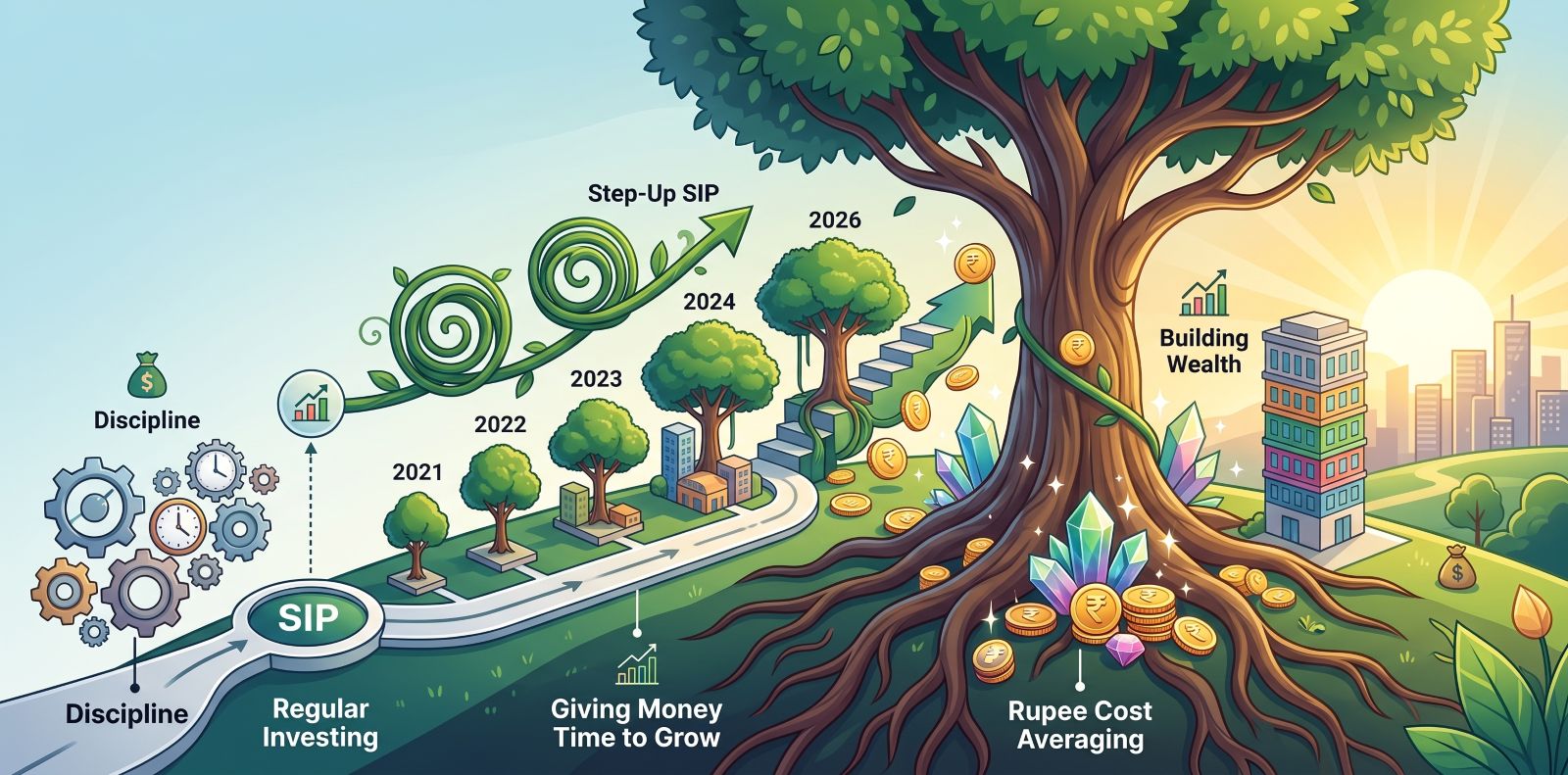
One potential advantage of investing through an SIP is rupee-cost averaging. By investing a fixed amount regularly, investors purchase more units when the NAV is lower and fewer units when it is higher. For example, if you invest ₹5,000 per month, you may accumulate more mutual fund units during a market decline than when the NAV is higher. Over time, this approach can help manage the average purchase cost of your investments. However, rupee-cost averaging does not guarantee profits or protect investors from market losses. Benefits and Risks of Continuing Your SIP During Market Volatility
Benefits
Investment Discipline — Regular investing can help investors avoid making impulsive decisions based on short-term market movements.
Rupee-Cost Averaging — Fixed investments purchase different quantities of units at different NAVs.
Long-Term Wealth Creation Potential — Equity investments may support long-term financial goals when aligned with an investor's risk profile and investment horizon.
Consistent Investing Habits — Continuing a suitable SIP can help maintain financial discipline during uncertain market conditions.
Risks
Market Risk — Mutual fund investments can lose value during market downturns.
Prolonged Recovery — Markets may take longer than expected to recover, or may not recover to previous levels within an investor's time horizon.
Fund-Specific Risk — A fund may underperform because of its investment strategy, portfolio composition, or other factors.
Liquidity and Financial Needs — Continuing an SIP may not be appropriate if an investor needs money for essential expenses or has insufficient emergency savings.
Should You Stop Your SIP When It Is in the Negative?
A negative return alone is not necessarily a reason to stop your SIP. Before making a decision, consider your financial goals, investment horizon, risk tolerance, and the suitability of your mutual fund. Review the fund's investment objective, portfolio, benchmark performance, expenses, and risk characteristics. If your financial situation remains stable and the fund continues to meet your needs, maintaining your investment plan may be reasonable. However, if your goals have changed, you need the money soon, or the fund no longer suits your risk profile, reviewing your investment strategy may be appropriate. For HNIs and UHNIs, SIP performance should also be evaluated within the broader portfolio, considering asset allocation, liquidity requirements, diversification, and overall wealth-management objectives.
How to Manage Your SIP During a Market Downturn
Investors can follow a structured approach when their SIPs show negative returns.
Review Your Financial Goals — Determine when you need the invested money and whether your investment horizon has changed.
Evaluate Your Mutual Fund — Assess the fund's strategy, performance, portfolio quality, and risk level.
Maintain Diversification — Avoid excessive exposure to a single sector, market segment, or investment strategy.
Protect Your Emergency Savings — Ensure that essential expenses and near-term financial needs are covered.
Avoid Emotional Decisions — Do not stop, increase, or switch your SIP solely because of short-term market movements.
Seek Professional Guidance — Consult a qualified financial adviser if you need help evaluating your portfolio or asset allocation.
Conclusion
Understanding what happens when your SIP is in the negative can help you approach market volatility with greater clarity. Historical market corrections, including those in 2008, 2020, and 2022, demonstrate that markets can experience sharp declines as well as periods of recovery. However, no recovery is guaranteed, and every mutual fund carries risks depending on its underlying investments. Rather than reacting to negative returns alone, investors should evaluate their financial goals, investment horizon, risk tolerance, and fund suitability.
At Samarth Capital, informed investing begins with understanding risk, maintaining a suitable investment strategy, and making decisions based on long-term financial objectives rather than short-term market movements.
Disclaimer: This article is for educational purposes only and does not constitute investment advice or a recommendation to buy, hold, or sell any mutual fund. Mutual fund investments are subject to market risks. Please read all scheme-related documents carefully and consult a qualified financial adviser before making investment decisions.
FAQs on SIP Negative Returns
Why is my SIP showing negative returns?
Your SIP may show negative returns when the current market value of your mutual fund units is lower than the amount invested. Market corrections, fund performance, and a short investment horizon can contribute to this situation.
Should I stop my SIP if the market falls?
Not necessarily. Review your financial goals, investment horizon, risk tolerance, and fund suitability before making a decision. A market decline alone does not determine whether your SIP is appropriate.
Can an SIP recover from negative returns?
An SIP can return to positive territory if the fund's value recovers sufficiently. However, the timing and extent of any recovery are uncertain, and losses may continue.
Does investing during a market downturn help?
Regular investing during a downturn may allow investors to purchase more units at lower NAVs. This can reduce the average purchase cost in some circumstances, but it does not guarantee positive returns.
How long should I stay invested in an equity mutual fund SIP?
The appropriate investment horizon depends on your financial goals, risk tolerance, and fund category. Equity mutual funds are generally better suited to investors who can tolerate volatility and remain invested over the long term.
Is a negative SIP return a reason to switch mutual funds?
Not automatically. Investors should evaluate the fund's investment objective, performance relative to an appropriate benchmark, portfolio, risk profile, and suitability before deciding whether to switch.